Showing posts with label Science Fiction. Show all posts

25 April 2013

G.I. Joe: The Movie


United States - 1987
Director - Don Jurwich
Celebrity Home Entertainment, 1995, VHS
Run Time - 1 hour, 33 minutes

28 March 2013

Ultra Warrior


Ultra Warrior
United States - 1992
Director - Augusto Tamayo and Kevin Tent
New Horizons Home Video, 1992, VHS
Run Time - Ah shit, well, probably around an hour and 20 minutes.

Not really an original movie, but a frankenfilm cobbled together from a number of other film scenes and stitched with a little extra footage.

01 February 2013

Dr. Who & the Daleks


United Kingdom - 1988
Director - Gordon Flemyng
Goodtimes Home Video, 1989, VHS
Run Time - 1 hour, 18 minutes

14 December 2012

Star Slammer


a.k.a. Prison Ship
United States - 1988
Director - Fred Olen Ray
Vidmark Entertainment, 1988, VHS
Run Time - 1 hour, 26 minutes

01 August 2012

Nemesis 4: Cry of Angels


United States - 1996
Director - Albert Pyun
Avalanche Home Entertainment, 1996, VHS
Run Time - 1 hour, 23 minutes


Thanks to NIRVANADOREMI for this entertaining collection of scenes featuring some of the best Blanca Copikova scenes from Nemesis 4. Just watch this a few times and you're set for a week.

30 July 2012

Velocity Trap


United States - 1999
Director - Phillip J Roth
Columbia Tristar Home Video, 1999, VHS
Run Time - 1 hour, 29 minutes


23 July 2012

Expect No Mercy


Canada – 1995
Director – Zale Dalen
Imperial Entertainment Corp., 1995, VHS
Run Time - 1 hour, 31 minutes

What?
The 1990’s was a decade best described with the words “rich”, “fertile” and “loamy”, where just about any old pop-culture seed dropped on this heady mixture of adjectival modifiers yielded some sort of cinematic fruit. In Expect No Mercy Billy Blanks and Jalal Merhi cultivate their first team up since TC 2000 introduced us to the millenarian concept of next-week future dystopian Canada. I know it must be hard to believe that such a thing could actually exist, but in the future, Canada, or at least the immediate Toronto/Scarborough area is going to be perpetually threatened by some white guy or other with ambiguously evil plans from which Billy and Jalal will repeatedly be called upon to save it.

Head.
In this installment, anchored firmly in the center of the decade, evil white guy Warbeck runs a giant Virtual Reality dojo where he trains an army of mercenaries which he hires out for various unspecified industrial espionage conspiracies. Justin (Blanks) and Eric (Merhi) are both posing as “students” at the complex, and soon get hip to Warbeck’s nonspecific dastardly plot and attempt to thwart it with some martially artistic action versus exponentially ineffective faceless lackeys. Despite their overwhelming numerical inferiority, the heroes are captured and subjected to a series of virtual reality battles with goofy ‘90’s video-game vilains. The digital environments are actually more aesthetically appealing than the industrial-park architecture and interior design styles in the rest of Expect No Mercy proving beyond a pixelated shadow of a doubt that unfinished slabs of bare concrete will be at the cutting edge of the future. A disappointment to be sure.

Real.
Justin and Eric escape again of course and drag Expect No Mercy to its conclusion in a hail of gunfire and “kee-ai’s!”, but the Mortal Kombat-esque virtual reality scenes and Billy Blanks fishnet shirt prove to be the high-water marks and historically significant touchstones of this engagingly asinine film. For the benefit of fisherman-fashion enthusiasts and very-near-future science-fiction fans throughout the Toronto metropolitan area, this makes Expect No Mercy one of the most visually exciting parochial dystopias available for retinal consumption.

11 April 2012

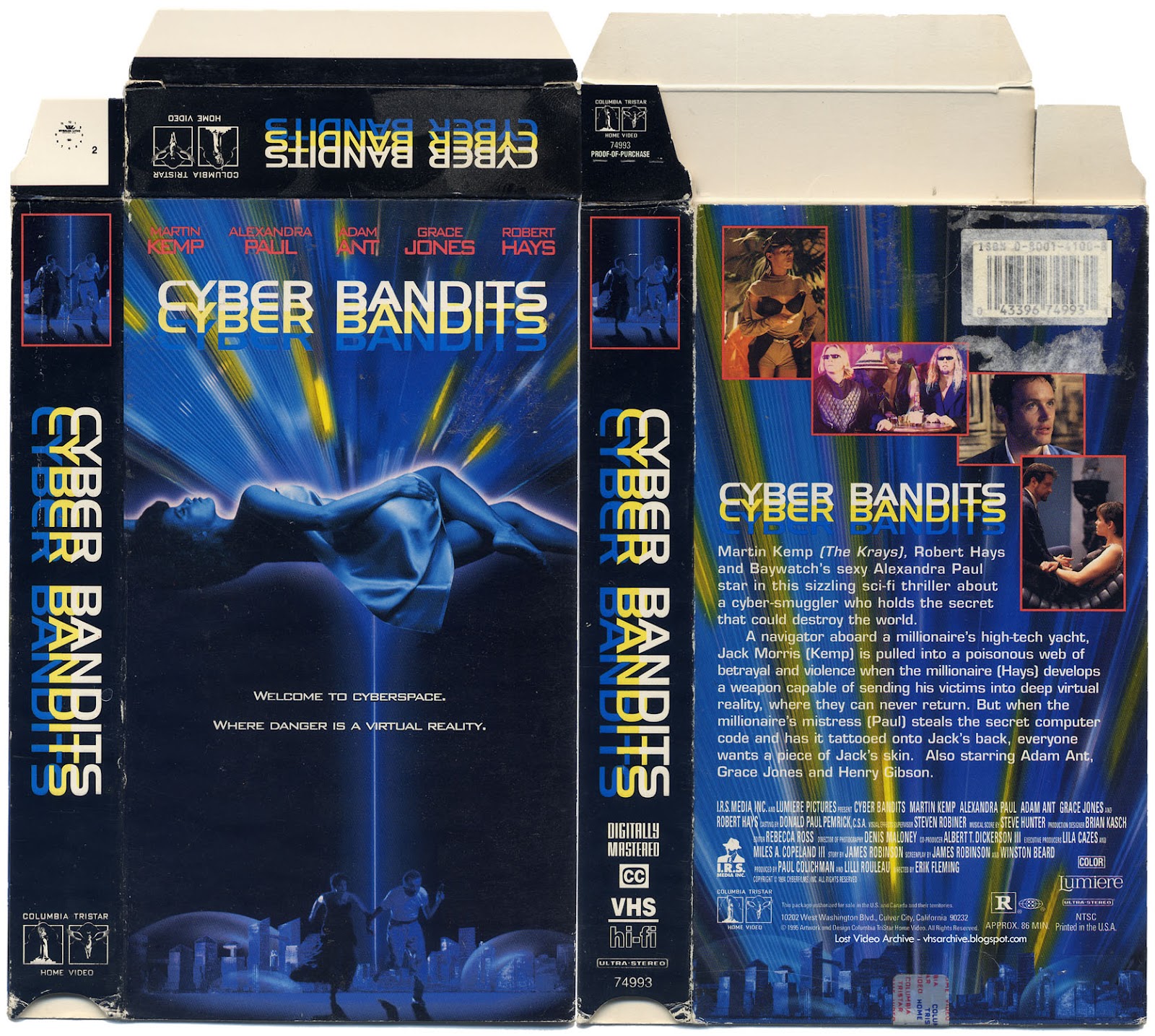
Cyber Bandits


United States - 1994
Director - Erik Fleming
Columbia Tristar Home Video, 1995, VHS
Run Time - 1 hour, 26 minutes

Cyber Bandits is a low-budget middle-90's action/drama that relies on barely-there technological concepts like CD's and virtual reality to lend itself a thin veneer of edginess. While it is probably most notable for starring Grace Jones as the daughter of James Hong, Cyber Bandits also goes down in my ledger for starring a guy who looks like my uncle and for being generally boring and poorly-acted and  laughable.


James Hong manages, despite his roughly 2 and a half minutes of screen time, to be the most interesting character in the film

Thanks to all the Week of Hong Contributors
Lost Video Archive - Teen Lust, Gladiator Cop, Cyber Bandits and Blade in Hong Kong

05 March 2012

Obsession: A Taste For Fear


Italy - 1988
Director - Piccio Raffanini
Imperial Entertainment Corp., 1989, VHS
Run Time - 1 hour, 30 minutes

Some of my favorite future-sci-fi movies are the ones set in a year which, by the time I see the film, has already passed. I just love laughing at vintage dreams. Even post-apocalyptic films usually do the same thing. They may be dystopian but usually they are typified by fantastic technology and absurd fashion, strange languages. But my, things sure didn’t end up nearly as awesome as they thought they would. Still you can’t help but sympathize with the poor optimistic suckers. Just like we all often do, these films imagined and hoped for something different and better than what they had. Most of them did anyway. There was one era which was so narcissistic that it didn’t really look forward for the future so much as in the mirror.

It is hard to see it now except in film because that is such an all encompassing medium. But if movies are any kind of cultural barometer, the 80’s was so convinced, so all fired sure that the it was the raddest that stuff would ever get, that it cocieved a future that looked, sounded and acted just like itself. Obsession: A Taste For Fear takes this sort of instantaneous self-adoration to new circular depths. It starts with a cookie-cutter thriller/Giallo plot in which young women keep turning up dead and at one time or another everyone is a suspect. Australian actress Virginia Hey stars as Diane, a snotty fashion photographer whose ex-husband George makes abstract video porn. Both call their work “art” presumably because it features boobs, neon and computer screens; all sure to be popular in the future. Soon, their shared models begin to get killed off, their deaths filmed in videos that look just like Diane’s photos and George’s pornos. And just like Obsession: A Taste for Fear. Of course, this makes both of them prime suspects and a surly cop chases them around between scenes of harshly-lit softcore and second-string period hits on the soundtrack. Finally Diane’s gay assistant is revealed to be the killer and Diane herself retreats cathartically into her pornographer Ex’s reassuring grasp. Ladies and gay men take note; the future may remain less than liberatory.

Wow, I honestly don’t know if I can compute that. If the future is exactly like right now how do we know it’s even the future? Truth be told, Obsession does have an odd looking car in one scene and I heard a rumor about a ray-gun somewhere. There are a few computers that clack and bleep so that’s peripherally, hintingly supposed to be the future I guess. What gave it all away though was the overwhelming sense that what was happening on screen, and on the screens on screen, and on screens on screens on screen, was the most significant and important thing that could happen. It was the feeling of imminence exuded like last night’s cocaine from every solipsistic pore of Obsession that made it an exercise in self abuse. It’s the sort of future that looks great in everything except the rear-view mirror.


20 February 2012

Saturn 3


United Kingdom – 1980
Director – Stanley Donen
CBS/FOX Home Video, 1987, VHS
Run Time – 1 hour 28 minutes 

Until my friend laid this old tape in my hands I had never heard of Saturn 3. That isn’t saying much I suppose, but he hadn’t either, and we are both big fans of robot oriented space-fiction so it was a pleasant surprise. Before watching the film I did a little research and discovered some interesting stuff. Despite not initially wanting to write extensively about what is a fairly mainstream film, after watching I was inspired to say something about it its relationship to space-fi in general.

When it was released, Saturn 3 appears to have received generally negative reviews, and remarkably, continues to do so . Not surprisingly these predominantly appear to stem from unfavorable comparison to Star Wars, which was released just a few years before. Although not mentioned in anything I read, I think it also owes a large debt to Kubrick’s 2001 in both overall plot, and Elmer Bernstein's score. But even if it’s not exceedingly original, Saturn 3 does a damned good job of wearing it’s pedigree on its sleeve.

The important thing to remember about Star Wars, especially because it has compounded its cultural significance in the last decade, is that it wasn’t very creative. As I’ve said before, it’s an entertaining movie, but the plot as we know is a generic and predictable white hero myth. Saturn 3 is not as epic or inspiring than its predecessor, but neither is it any less creative. What was so remarkable about Star Wars (and this is what I think most people find so endearing about it) was the visual design. Saturn 3 interestingly enough, was written and (initially) directed by John Barry, the same man responsible for the look of Star Wars.

The story itself centers around Adam (Kirk Douglas) and Alex (Farah Fawcet) on one of Saturn’s moons where they operate a hydroponic farm but mostly shag. When another astronaut, Benson (Harvey Keitel) arrives at their secluded love nest, they soon discover that he and his robot are not on a mission of peace. Compelling? Perhaps not, but visually everything in this movie, from the spacesuits to the ships clicks. The thing that really sells it for me is the robot, “Hector”, an eight foot tall machine powered by a giant tube of vat-grown human-fetus brains. The concept is pretty twisted if you think about it, and the way in which Hector takes on the sociopathic personality of its programmer Benson is particularly well conceived.


I’ve always cushioned my disappointment with the termination of sci-fi cinema’s great sagas with a simple philosophy; If the human geography of space has been expanded as much as my favorite films claim, then it is quite possible that each space-fiction film (of a nominally similar quality) merely represents another local facet in the same broad story. In that sense, there is no “end” to what I call the Space-Fi Narrative Continuum*. Garnished with moments of genuine intelligence and clothed in awesome visuals, Saturn 3 definitely makes the cut.

*In the future I'll refer to qualifying films under this label. Previously reviewed films which qualify have been back referenced.


 This Japanese poster is from Movie Outlaw

26 December 2011

Theodore Rex


United States – 1995
Director – Jonathan Betuel
New Line Home Video, 1996, VHS
Run Time – 1 hour, 32 minutes

Sometimes in the process of poisoning my mind with all these films I stumble across one that, despite its relative availability, just demands closer inspection. After watching Theodore Rex, there are a lot of things going through my mind. It’s a mess of confusion and wonderment up there, a jumble of emotion, fright, anger and even some sadness. I feel a little bit dirty. In case you are too young, have forgotten, or never had the pleasure of knowing at all, I’ll give you a quick refresher on the plot. In a nominally sci-fi future dystopia, detective Katie Coltrane (Whoopi Goldberg) partners with a bumbling, human-sized talking Tyrannosaurus Rex (“Teddy”) to solve the murders of several other dinosaurs. Much “hilarity” ensues. However, there is something much more problematic here than the fact that a talking dinosaur has just been given a job as a cop.


On the surface Teddy is an “adult” who drinks, chases women and has a job.  But because he talks, dresses and acts like a child, he is the film’s demographic selling point and titular hero.  Despite, or perhaps because of, his best efforts to channel Axel Foley, our “hero” is given all the attributes of the constantly frightened or mistake-prone sidekick. The subsequent hour and a half wallows in the resentment of his human counterparts. They make no secret of their contempt when such an obviously inferior creature is given a toy job on the police force in order to placate dino-rights activists, (I’m not making this shit up.) Even Whoopi uses the closet-bigot’s time honored phrase “you people,” (errr, dinosaurs.) In this light, we must recall that Theodore Rex is a product of the decade that gave us such PC Tokenism as the Americans with Disabilities Act and the backlash against Affirmative Action. As such, its bitterness towards childlike-adults (read: the mentally handicapped) reeks of the sort of recrimination familiar to an artist forced to sacrifice his aesthetic vision on the altar of commercial viability. Beneath its kiddie, buddy-cop exterior, Theodore Rex is an agonized cry of outrage at the decline of that great imperialist institution, “meritocracy”.


When confronted with movies of highly subjective quality, one often hears the question “why did this seem like a good idea?” This is an understandable response, a reflexive reaction to offended sensibilities, but it’s too loosely used against movies that venture into uncharted territory. Specifically the question lacks definition, being too subjective to serve as any real criterion. Humans are after all gifted with creative, imaginative minds which should be used and enjoyed even if their vision is sometimes more than a little out of their grasp. This film however is one movie for which this overused question is entirely appropriate. The anti-hero has a long tradition in narrative storytelling. Theodore Rex however, takes the unprecedented step of removing the hyphen from the trope and being literally against its hero. This sort of meta-ethical flip-flopping is dangerous, because it dissolves the existential barriers between film, audience and film-maker. It is a mind-warping paradox that can lead to feelings of betrayal and revulsion for all three parties, and ultimately to the sort of resentment that causes a writer/director to quit making films altogether.


08 December 2011

Enlightened Racism in Rise of the Planet of the Apes

After a brief interruption in service, Paracinema is back in action. My critique of Rise of the Planet of the Apes, after stirring some controversy has been updated and is also back in action. You can read it in its entirety HERE and if you so desire, join in the dialogue.

Those of you regular LVA visitors will recognize my rhetorical style, extended somewhat further here because Planet of the Apes is one of my favorite franchises. I did a lot of research for this writeup including watching a number of other films and revisiting some other writers who offer critical analyses of race, pop-culture, politics and of course cinema.


Paris By Night 52


Paris By Night 52
United States - 1999
Director - Christian O'Shea
Thuy Nga Video 69, 1999, VHS
Run Time - Jeeze, I dunno, three cassettes worth.

Another multi-tape Vietnamese language variety show thing I found at a thrift shop. I'm sure there are lots of these out there, but I find 'em fascinating. This one in particular is awesome because of the science fiction angle. See also Saigon In Beverly Hills

29 August 2011

Ghost Warrior


United States - 1984
Director - J. Larry Caroll
Vestron Video, 1986, VHS
Run Time - 1 hour, 26 minutes

Another Charles Band produced genre crossover spectacular from the early 80's. I re-found this one while looking for a movie about a frozen cave-man who comes back to life and kills people in the modern (80's) days. Any ideas what that might be?


These are the highest resolution versions that I could find of these two alternate posters.

01 August 2011

Yog: Monster From Space


1970 - Japan
Director - Ishiro Honda

My friend over at Manchester Morgue has been turning me on to some great kaiju movie music, and consequently I have giant monsters on the brain. This US poster (from IMPAwards) sure is awesome, too bad I can't find any artist signature to give credit where it's due.

25 July 2011

Arena


United States - 1989
Director - Peter Manoogian
RCA/Columbia Pictures Home Video, 1991, VHS
Run Time - 1 hour, 37 minutes

The list of mostly forgettable science-fiction popcorn films produced by Charles Band’s Empire Pictures in the ‘80’s is for the most part an unchallenging intellectual vacuum. In many cases that is what makes them so mindlessly entertaining. With a naïve innocence that can only come from sincerity and a (relatively) low budget, Arena is a shining example. It doesn’t require any mental acrobatics or ask any hard moral questions, but it was a little better made than most of the Empire Pictures catalog. Arena is at some six years distance, clearly riding on the coat-tails of Star Wars. It is not surprising then that in addition to its Empire pedigree, Arena should suffer from many of the same philosophical shortcomings as its source material.

With nowhere else to go after losing his job on a space-station somewhere in the universe, Steve Armstrong (Paul Satterfield) bunks with his former coworker Shorty in the slums. Here he meets a destitute bum, the last human champion of the Arena, an intergalactic boxing competition that has been dominated by aliens for the last five decades. He anoints Steve as the next human champion of the Arena making him quite literally the Great White Hope in space.

The man in the Sloth suit is future director Steve Wang

There are two categories of aliens that populate Arena and highlight Steve’s messianic status. Both are visibly differentiated from the protagonists. The first are helpers, house-aliens who are silly and or dumb but totally harmless. To remove any ambiguity, the second group, Steve’s rivals, are not only visibly different but especially hideous, making them even more clearly unsympathetic and evil, and giving the good aliens excuse to support the collective restoration of a properly ordered hierarchy  without appearing overtly Uncle Tomish. Steve’s final opponent, the present champion Horn is also a cyborg. As such he is not only a direct threat to and reaffirmation of human physical purity, but a confirmation of the physical corruption and immorality of the non-human which has to “cheat” in order to win. And in fact, that’s precisely what Horn’s manager Rogor does when it becomes clear that Steve is going to beat his fighter.

Jade (Sharri Shattuck) a sultry nightclub performer (Shattuck actually performs several of Richard Band's songs) and Rogor’s lapdog is sent to seduce and poison Steve before the championship fight. Yet despite a romp through the futuristic spacy mylar sheets in Jade’s cat-box, her eroticism does not bode well for the normative settled family relationship. Instead, there is Quinn (Claudia Christian,) a reserved, practical woman carrying on her father’s legacy as a boxing manager. It is with her faithful encouragement and training that Steve will restore hetero normative values to the universe. Can there be any doubt that our ubermensch will succeed in setting all of this straight when the distinction between right and wrong is so clear-cut?

The ultimate Buck?
Despite all of this 50’s era conservative paranoia, Arena is still enjoyable for a number of reasons. The practical special effects provided by Screaming Mad George are better done than most of Band’s films. Arena is also distinctly more working-class than its big budget franchise predecessor. Boxing, which is really all the Arena fights are, has always been viewed as a proletarian sport. Related to this is my final assertion that Arena’s settings capture perfectly the appeal of the mundane. From the diner of the opening sequence, to the slums where Steve is verbally identified as the hero (it’s always been visually obvious), to the contest itself where order is restored, Arena is fiction made tangible. Without throwaway details like burned eggs and garbage, it would be just another space movie. Narrative details that speak to perceived experience are what make good fiction. Unfortunately that’s why audiences rarely question such obviously reactionary symbolism when couched in throwaway sci-fi fluff.


This beautiful VHS insert comes from Japanese VHS Hell, go visit 'em!

08 June 2011

Slave Girls from Beyond Infinity


United States - 1987
Director - Ken Dixon
Amazing Fantasy Entertainment, 1987, VHS
Run  Time -  1 hour, 20 minutes

06 June 2011

Night of the Lepus


United States – 1972
Director – William F. Claxton

Monster movies come in all sorts of forms, subgenres and species. Monsters both in literature and in cinema are almost always a symbol for something more than just a monster. Night of the Lepus ranks alongside such trash classics as Them! , Slithis and Godmonster of Indian Flats as one of my favorite among the nature twisted by science flicks. Fear of atomic power, industrial pollution and even computers have all become cultural boogeymen reformulated as screen monsters. “Progress” is scary because it’s unpredictable, and because man’s intellectual reach outdistances his ethical grasp, and so on and so forth….

It wasn’t until a second watch through of Night of the Lepus that it suddenly dawned on me that the film is a not so thinly veiled parable for the issue of Mexican immigration that has repeatedly proven anathema to deluded United Statesian racists since at least the 19th Century. The rabbit metaphor should be a familiar one, although parallels between “breeding like rabbits” and well established stereotypes about low income ethnic groups are rarely drawn explicitly. “Takeover” by the exponentially reproducing vermin, which threatens to subsume their typical hardworking all-American victims and ruin their good cultural traditions is clear enough. In Night of the Lepus the growth of the rabbits to human proportions and their proclivity for fresh blood and flesh remains mysteriously unexplained leading me to believe that not only are regular sized rabbits just not scary, but that these Lepus are meant to be even more like their analogues, making them still scarier.

The solution in Night of the Lepus, as parroted time and again in real life immigration paranoia rhetoric and literally realized along the large portions of the U.S. Mexico border, is a giant fence. Not only does this one keep them out of “our” territory, but it's also electrified such that any invaders attempting to cross it are thoroughly electrocuted to crispy death.

It is likely true that we often find the evidence we’re looking for. The fact that the film was set in Arizona although based on a novel (Year of the Angry Rabbit) set in Australia, and that it so clearly reproduces established stereotypes about Mexican immigrants in an era immediately following the end of the Bracero Program (and new immigration legislation) is too much coincidence for me to bear! Night of the Lepus is nothing more than a hilarious and ludicrous reification of United Statesian white supremacist paranoia, but damned if it doesn’t make for some entertaining cinema.


Once you know what the movie is about, the posters become even more awesome.
This one is from The League of Dead Films

Is the tagline in this ad meant to mimic the 1967 race-film Guess Who's Coming to Dinner?

 Ads from Criticonline.